Seeds of hope

This sermon was shared at St Denys, Evington on 3rd December 2023. When the recording is available I will link to it here.

Hope. I wonder if, as you heard our passage read this morning, you found any signs of hope in them? I admit, when I first read them as I was preparing, they both seemed rather miserable – Isaiah 64 is part of a poem which is reflecting on a tragic part of Israel’s history, and Mark 13 focuses on the destruction of the Temple.

As I read in more detail though, and as I prepared for the sermon, I discovered seeds of hope in both. Starting with Isaiah 64, let’s see where these passages fit into the ‘big story’ of God and the world He created, a story full of a hope founded on the character of God.

Isaiah 64 describes God as our potter. I invite you to think about a potter, or other creative artisans and their relationship with their work. That relationship is permanent, in the sense that they cannot disown what they have made. In the same way, God is our potter, we are His craftsmanship – His created us, and His relationship with us is permanent and, in that regard, unchanging. God is our potter, our creator, our artisan. So what is this God, our creator, like. What is His character? This is our ‘seed of hope’, which I will return to later on.

The chapter starts by expressing a longing that God had acted, and begs God to come down and make His name known to His enemies. Isaiah is expressing the question every person of faith asks in times of tragedy or suffering – why hasn’t God acted? Quickly though, the prophet speaks with faith.

“Since ancient times no one has heard,
no ear has perceived,
no eye has seen any God besides you,
who acts on behalf of those who wait for him.”

Isaiah 64:4


The Jewish faith is clear that there is no other God except Yahweh, and the prophet echoes this belief. This God, Yahweh, is holy, set apart, and acts in particular, unchanging ways:


1) God acts on behalf of those who wait for him


God acts on behalf of those who have a patient, confident and expectant faith, a faith that simply trusts without wavering in God’s promises.


This advent, I am using Mary’s Voice, by Amy Orr-Ewing for my reflections. What has struck me each day so far has been Mary’s trust that God’s word to her would be fulfilled, and echoed by her relative, Elizabeth as she blesses Mary with the words “Blessed is she who has believed that the Lord would fulfil his promises to her.” Trust that God will fulfil His promises, a trust that changes how we behave, is central to following God.
I invite you to pause and reflect on what God’s promises to you have been, and what it would it would look like for you to wait patiently for God – to trust in His promises.


2) The moral requirement of doing right, gladly.


The Hebrew literally reads as “those who rejoice and do right”. God is holy, and ‘righteousness and justice’ are the foundation of His throne, so those who do not do right, those who sin, are separated from Him and cannot draw near to Him, they cannot expect God to help them.

The problem, for Isaiah and the people of Israel, and for all humanity, is that they, as we do, continued to sin, and did not remember God’s ways – Isaiah acknowledges that this makes God angry! How then can we be saved?


The reason why our sin is such a serious issue is described by Isaiah

“All of us have become like one who is unclean, and all our righteous acts are like filthy rags”

Isaiah 64:6a


Our sins make us unclean! Even our good deeds look like filthy rags, because everything we do is affected by our fallen, sinful nature. Our sins alienate us from God – we cannot call on God’s name, we cannot ‘lay hold of God’, because God has hidden his face from us. We are internally, spiritually and practically separated from God, and this has a serious effect.


Using pictures from nature, Isaiah describes the effect of our sin. We “shrivel up like a leaf”. Alienated from God who gives us life, we shrivel up and die, as a leaf detached from the plant that gives it life shrivels up and dies, and the wind sweeps us away, just as the wind sweeps away the shrivelled up leaf.


How then can we be saved?


And so we return to our ‘seed of hope’, the description of God as our potter. Isaiah calls God ‘Father’, and expresses in faith that we are ‘all the work of your hand’. It is this that means that Isaiah can plead for mercy, for God to not remember his people’s sins forever. We, too, as pots made by God our Father, can seek His mercy.


Turning now to our gospel reading, this passage may seem quite complex and difficult to follow. You may have heard it taught on as being about ‘the end times’ or Jesus’ return. I’m not so sure. The focus of Mark 13 seems to be the destruction of the Temple, which happened in 70 AD, so if this part of the chapter is about Jesus’ return at the end of the age, then v30 is problematic – the generation of the time passed away nearly 2000 years ago, and we are still here, waiting for Jesus to return!


The clue is found in recognising the texts that are behind the imagery in this passage. The most important come from Daniel 7, about the Son of Man ‘coming to’ God after suffering, the triumph and vindication of the Son of Man. These factors lead Tom Wright to suggest that, rather than being about ‘the end of the world’, Mark 13:1-31 is about ‘the end of the world as people knew it’, the end of the Temple and Temple sacrifices, and a vindication of Jesus as the Son of Man, God’s Messiah. Others suggest that there are two focal points in Mark 13 – the destruction of the Temple, and then, in our passage, a focus on the end times.


From verse 32, the command is clear, “Keep awake, be alert!”. Given the earlier focus on the destruction of the Temple, this with the urge to notice the ‘signs’, is most likely directed at the disciples and the early Christians – to notice the signs of the destruction of the Temple, and to flee to the mountains, as verse 14 states. This doesn’t mean that we have no need to be alert though. The destruction of the Temple, and the city of Jerusalem, can be seen as a foretaste of the judgement of the world. This time we aren’t told of any signs to look out for, no advance warnings. There is only the command to Christ’s people to be faithful to him, without compromise to the changing fashions of our present culture, to keep awake, keep alert.

In advent, we remember Jesus’ coming as a baby, his incarnation as a human being, who came to ‘wash our dirty linen’, if you like, and reconcile us to God, presenting us before His Father in the clean clothes of His righteousness, rather than the stained clothes that we are able to manage at our best. We also look forward to the day when Jesus returns to judge the earth.

How can we be sure that we’ll be able to stand before Him on that day? By trusting in God’s promises, trusting in Jesus’ sacrifice, resurrection and ascension, God comes to our help and acts on our behalf in Jesus Christ, clothing us in Christ’s clean clothes rather than our filthy rags. These seeds of hope sustain us as are keeping watch ‘through the night’ of waiting for Jesus’ return, doing what is right with joy and remembering God’s ways.

Remembering the promises

This sermon was shared at St Denys, Evington at a service of Evensong on 16th April 2023, the second Sunday of Easter. Unfortunately, there isn’t a recording available for this service.

There are so many emotions, named and un-named, in Mark’s account of the burial and resurrection of Jesus! Mark tells us that Joseph of Arimathea is ‘bold’, and Pilate is ‘surprised’ to hear that Jesus is already dead. Left unsaid is the shock, sadness and grief of burying a friend and teacher, even more so one whom they believed would save Israel from the Romans instead being crucified by the Romans! Left
unsaid, too, are all the emotions of the Sabbath, the day in-between, the fear, grief, confusion and sadness that comes once the initial shock has happened.

On their way to the tomb, Mary Magdalene, Mary the mother of James and Salome are having an
anxious conversation about who will roll the stone away, when they see the angel, they are ‘alarmed’, and afterwards we are told that ‘terror and amazement had seized them’, and they fled, ‘afraid’. The emotions left unsaid are the emotions expressed in the angel’s words. As I read them again, what emotions can you hear?

“Do not be alarmed; you are looking for Jesus of Nazareth, who was crucified. He has been raised; he is not here(!). Look(!), there is the place they laid him. But go, tell his disciples and Peter that he is going ahead of you to Galilee; there you will see him just as he told you.”

Sometimes, people try to explain away the resurrection by saying that Jesus wasn’t really dead. It’s clear from Mark’s burial narrative that Pilate wasn’t going to let that happen – the Roman soldiers were well experienced in executing people – they weren’t going to make a mistake in this case. Other times, people say, “the disciples stole the body”. It’s not mentioned in Mark’s account, but again, we know from the other accounts that Pilate had already been alerted to this possibility, and guards were stationed by the tomb. Finally, both Joseph, who buried Jesus’ body, and the women who had come to finish the preparations of the body, knew death, they knew that bodies didn’t just disappear! Indeed, in John’s account, we have Mary Magdalene asking Jesus, who she thought was a
gardener, where he had put Jesus’ body. The women themselves would have more readily believed that Jesus’ body had been moved than that Jesus had been resurrected from the dead, and were ‘terrified and amazed’ after their encounter with the angel. Despite all this, word of Jesus’s resurrection spreads. Why? The simplest, and most obvious explanation, is that Jesus really did rise from the dead! When our emotions swirl around, when the challenges and trials of life impose themselves on our minds, how can we make sure we don’t miss the excitement and joy of heaven that was first shared by an angel in an empty tomb? I think the angel’s words give us some pointers.

First, the angel shows the women ‘the place where they laid him’. The angel directs the women to
use the evidence their eyes are showing them. They knew bodies didn’t disappear. We can be sure,
too, that the women knew that the disciples were currently hiding, locked in the upstairs room, too afraid to leave. Looking at that space would have left only one explanation. An explanation that would have been both terrifying and amazing at the same time. That this rabbi, their teacher, had risen from the dead. Terrifying because that meant that this rabbi could only be God’s Son – who else could rise from the dead? Amazing, because that meant that Jesus was alive Ask God to show you the truth, and use the evidence of your eyes. Don’t let emotions, confusing questions or uncertainty sway you. Those things can, and will, pass. The truth of Christ’s resurrection remains.

Second, we can remind one another, and ourselves, of Jesus’ words, and promises to us. The
message to the disciples is that Jesus is ‘going ahead of them’ to Galilee, and that they will see him
there, as Jesus had told them. What promises and words of Jesus do you need to be reminded of today?

Thirdly, the women also needed to be reminded of Jesus’ words, and, once they had been
reminded, their task was to remind others. Are there promises from God that He is asking you to remind others of This week, I encourage you to spend some time praying for those you know, and asking God who you can remind of His promises. Some of those people may not be people who regularly attend church, or would even call themselves ‘Christian’, but many people have heard promises and words of hope, which the pressures and emotions of life have overwhelmed. Some, perhaps, used to follow Jesus closely, but have lost hope, as the disciples had following the
crucifixion. So finally, who can you share the hope of Christ with, and remind them of Jesus’ promises?

God’s reconciliation plan

This sermon was given at St Denys Evington on 5th March 2023. An audio recording will be linked to when it is available.

I know that we have a number of keen photographers in the congregation. When we take a photo, we can take a wider-view picture, or we can zoom in to capture the detail, perhaps of a flower, or an animal or of something else that we want to be able to see more closely. Up until Genesis 12, Genesis has given us wider-view pictures, and we speed through them very quickly – 21 generations in 11 chapters. The rest of Genesis, and the Old Testament, zooms in on the family of Abram – his son, grandson, great grandsons and their descendants.

To start, we are told about Abram’s first recorded meeting with the LORD. In this meeting, we discover the promises the LORD makes to Abram, and the
invitation to Him to be part of extending God’s blessing to others. It’s a prequel to the story of Abram, and the story of God’s reconciliation plan for the whole world. God has chosen a family through which His reconciliation plan will be carried out – the family of Abram. Later, in Genesis 17, God will give Abram a new name, Abraham, to drum home to him the promise that was first made in Genesis 12 – that Abram would become a ‘great nation’ – a father to many. For now though, his name simply means ‘exalted father’ – not a bad name, by any means, except for one problem – his wife was unable to conceive, so he didn’t have any children, and so, no heir. This promise would only happen through the power of God.

Let’s now fast-forward in the story of God’s reconciliation plan, to our gospel passage, from John 3. Nicodemus, as a good Jew, a Pharisee and teacher of the law, knew that what family you were part of was important. The LORD had blessed Abraham, and set apart the descendants of Jacob, so you needed to be a child of Abraham – that was the Jewish teaching. In his visit to Jesus at night, Nicodemus hears something radical. Being part of God’s family, the kingdom of God is completely different. It doesn’t matter who you are physically a child of, being a part of God’s family is open to everyone who believes in God’s Son – Jesus Christ.

So, how does someone become a part of this family? In the church, we often talk about ‘believing in Jesus’ as if it’s obvious why we need to, or what it means or looks like. For many, it’s far from obvious. In fact, it wasn’t obvious or clear even to Nicodemus – a religious teacher of Israel!

Jesus uses a couple of different images to explain what he means – one from nature, and one from Israel’s history.

To explain why we need to believe in Him, Jesus looks back to Israel’s history, to a story Nicodemus would have known. In the wilderness, before the
Israelites arrived in the promised land, the Israelites grumbled against God and Moses, and so God sent venomous snakes amongst them – a consequence of their sin. Then God told Moses to build a bronze snake and lift it up on a pole, so that when the people were bitten, they could look at the snake and live. Jesus likens himself to the bronze snake. Humanity has a deadly disease – sin. Jesus took all our sin upon himself, despite being without sin, and was lifted up onto a cross. The only cure for our deadly disease is to look at the Son of Man dying on the cross, and find life through believing in Him – that is by looking at Jesus and trusting that we will live because Jesus has died in our place.

The gospel passage draws to a close with perhaps the most famous verse in the Bible: “God so loved the world that he gave his one and only Son, that whoever believes in him shall not perish but have eternal life.” This verse doesn’t just tell us that God loves the world so very much, it tells us what God did to show us that love. The Greek phrase translated “God so loved the world” is perhaps more accurately translated “In this way God loved the world”. I can’t imagine a greater love than that shown by God giving his only Son. God did not do this to condemn the world, but to save the world. The sending of His Son is the climax of God’s reconciliation story, the moment
where the great plan to restore our relationship was fulfilled.

To become part of God’s kingdom family, we need to be baptised in water and the Spirit. Some think that water simply refers here to our physical birth. I’m more convinced, though, that the water refers to the water of baptism, because of the context in the passages around it – such as, John the Baptist baptising with water to reveal Jesus to Israel, and saying that Jesus baptises with the Spirit.

Jesus explains the work of the Spirit by pointing to the wind. Even today, with a more scientific understanding of what wind is, we cannot completely control natural wind. Whilst we can have an idea of the direction it comes from, we only have that from the effect of the wind – how it blows on weather instruments, weather vanes and objects around us. Whilst we can perhaps harness the power of the wind, for windmills, turbines and so on, we are yet to actually control the wind and get it to blow, or not blow, when and where we want – that, of course, is the challenge with “wind power” that we hear so much about. Only God can control the wind, Jesus says, and so it is with everyone born of the Spirit – only God can direct where His Spirit moves.

To be born in water and Spirit is a double baptism, first in water, bringing us into the kingdom-movement, and secondly in the Spirit, the new life that Jesus offers, bubbling up within us. This new life changes everything. Through it, we, like Abram, are invited to be a blessing to others, introducing them to the One who can bring them new life as He was lifted up on the cross.

Many of you here will have been baptised with water, and know that you have God’s Spirit living in you. If that’s the case, I invite you to spend some time thinking about those who you could invite to look at Jesus and receive the new life He brings.

If you haven’t been baptised with water, or aren’t sure if you have the new life brought by the Spirit, I invite you, today, to look at the cross, and look at Jesus lifted up. The cross is a sign for us, a sign to believe, and live. Please do come and talk to one of the staff team after the service. If you know that you have looked to Jesus on the cross, but haven’t yet been baptised, and would like to explore this, please do speak with Anthony or Mark after the service.

This new life changes everything. Jesus is lifted onto the cross as a sign to each of us, a sign to believe, and live. Amen.

The God who shares our grief to bring reconciliation

This was first shared as a sermon at St Denys Evington on 29th January 2023. The audio can be found at the bottom of the page.

Suffering was the way of life for Simeon and Anna, Joseph and Mary. Suffering is the way of life for us, too. Be that the personal suffering of illness, grief, and damaged relationships, or the suffering we are witness to locally and globally, from the climate crisis, or oppression or war, suffering is all around us. And we cry, “It’s not fair! It shouldn’t be like this!”. Some of us cry to God, some of us cry to the universe, those around us, the media or anyone who will listen, but we are united in feeling that this suffering shouldn’t happen. Why?

In short, the reason is that the world was not meant to be “like this”! God created the world, and everything was good! Until…

… until humanity was tempted by the idea of ‘knowing good and evil’ – of being able to make the judgement of what was right and wrong for themselves, or, as Genesis 3 describes it, were tempted to eat the fruit of the Tree of the “knowledge of good and evil”. The authority and power to make that call belongs only to God – that was why Adam and Eve were told “not to eat the fruit” of that tree. Sometimes we see the consequences of this clearly – when harm occurs as the result of particular actions. Other times, it’s less obvious to us, but ultimately, humanity’s relationship with God was broken, collectively and individually, and the result of this affects the whole of Creation. As a result of this broken relationship, we experience death, and humanity lives under the slavery of the fear of death.

Humanity was the pinnacle of God’s Creation, but it had damaged itself, the world and its relationship with God, seemingly beyond repair. This grieved God.

Grief, the word we use to describe the pain we experience when we lose a loved one. When humanity sinned, God lost His loved ones. How could this relationship be restored? How could God reconcile us to Himself, and set us free from our enslavement to the fear of death?

There was, and is, only one way. God started to write the story of the restoration of His Kingdom through Abraham, Isaac and Jacob, through Moses and the Law in the Old Testament, and through the prophets. Then God acts, and the story is written through Mary and through Joseph – God sends His Son, to become flesh and blood, to become a vulnerable baby in a hostile world, in a world full of the suffering which should not be.

Simeon and Anna are part of the story, too. Righteous and devout, Simeon is waiting for the consolation of Israel – the promised Messiah who would restore Israel, and probably carried his own personal suffering as well as that of his people. Anna, now aged 84, is a prophet, was married for 7 years and had been a widow for many years, and all that time has been worshipping God, night and day, in the Temple, fasting and praying. Simeon and Anna are waiting in hope for the promise of God’s Kingdom.

The Letter to the Hebrews describes the climax of the story that God has been writing: that Jesus, coming to rescue humanity, shared our flesh and blood and shared our fate – the fate of suffering, the fate of death. In sharing in flesh and blood and in sharing in death and suffering, He frees humanity from their enslavement to the fear of death. Just before the passage we heard read, the author of Hebrews writes about the family of God, about how all those who are sanctified – that is ‘made holy’ – are Jesus’ brothers and sisters, and it was because we are His brothers and sisters that Jesus became man, took on flesh and blood.

This is the wonder of the incarnation – that God’s Son would become like us “in every way”, having flesh and blood, experiencing suffering, temptation and death, and because of this we are able to be called “children of God” and Christ’s brothers and sisters!

Hebrews talks a lot about Jesus as high priest. Not just ‘like’ a Jewish high priest, but perfectly fulfilling the role of a ‘high priest’, as intended by God from the beginning. A high priest should be:
Someone who is able to act as God’s representative, without sin, embodying God’s mercy and faithfulness
Whilst, at the same time:
Being someone who is able to fully sympathize with those to whom he ministers.

Jesus is the only One who is able to do both – fully God and fully human, experiencing temptation yet was without sin, and so able to free us from the fear of death.

In Christ, we are reconciled to God, and so the consequences of humanity’s broken relationship are no longer binding – Jesus has defeated death, and not only death, the one who held the power of death – that is the devil. The devil’s power has been stripped away by Jesus dying on the cross and rising again.

Like Simeon and Anna, we are also waiting. There’s an important difference between our waiting and Simeon and Anna’s. Jesus’ defeat of the one who holds the power of death means that we have a certain hope as we wait for the final fulfilment of the story of God’s Kingdom to come on earth. God’s promise has already come, we know that it is here and that God will keep His promises, because Jesus himself showed us that God is merciful and faithful.

We are all invited to be a citizen of God’s Kingdom, and to be part of spreading God’s Kingdom and inviting others to be a part of it.

First, if you already know yourself to be a citizen of God’s Kingdom, then I invite you to ask God “what are you calling me to do?” It might be something out of the spotlight, quietly serving and sharing God’s love and the hope of God’s kingdom with those around you, as and when the opportunity arises. Or, it might be something that feels more uncomfortable, either in Church or in your everyday life, but you can’t get it out of your head. Or, it could be a bit of both! Either way, God has a part for each of us to play in His story. If it would be helpful to explore this with others, there is a day exploring what ‘calling’ – formal or informal – looks like at St Martins House on 11th February, have a chat with Anthony, Mark, Geraldine or myself after service.

Secondly, if any of this is new to you – the news of God’s Kingdom, the news that we can live free from the fear of death, the news that you are invited to be a citizen of God’s Kingdom, and you would like to accept that invitation, then, as I pray, I encourage you to join in, quietly where you are. Please do tell one of us if you join in, so that we can continue to pray for you.

Let us pray…

Lord Jesus, we thank you that you became one of us, with our flesh and blood, experiencing our suffering, trials and temptation, and even one of the cruellest deaths imaginable, to repair the relationship between us and God. We thank you that because of this, you have defeated the one who holds the power of death, and give us the gift of life free from the fear of death.
I thank you that you have done this for everyone here, including me. I want to be a citizen of your Kingdom, and I know that that is only possible through you. Forgive me for the times when I have decided for myself what is right and wrong, and lived life my way. I choose to live life your way, instead. Amen.

Audio of sermon from 29th January 2023

“Never complain”

I want to talk some the idea of “never complaining” particularly in the context of long-term illness and/or disability.

We come across this a lot, in media, on social media, amongst our friends and family, and even, in our own minds. The idea that we shouldn’t complain “too much”.

I’ve been struck recently about how, when we see stories of those who live with a long-term illness or disability, or share those stories ourselves, someone always says, as a compliment that this person “never complains”, the idea being that they endure so much pain and suffering, but never (or hardly ever) mention it, get on with life ‘with a smile’ and “grin and bear it”.

This is as true, if not more so, of the disabled community than wider society, perhaps because we want to avoid the “pity parties” and want people to know and understand that our lives are as worth living as everyone else’s, that we are able to live a full and fulfilled life, sometimes because of, not just in spite of, our disabilities. I wholeheartedly relate to wanting to avoid the pity of those who are able-bodied, and fully endorse that our lives are “as worth living as everyone else’s” and that we can and do live full and fulfilled lives both because of, and in spite of, our disabilities. BUT… and it’s a big but…

All this isn’t to say that we aren’t suffering, that we don’t need to be able to name that suffering, and yes, complain about it, as frequently as we feel it. Absolutely we cannot, and do not wish to become mired in grief of “what could have been”, or become so preoccupied with our pain and difficulties that functioning in daily life becomes almost impossible. We also recognise that all those who love us want us to be better, to not be in pain, to not suffer. However, for all that longing, making us hide our pain and pretend we are “OK” when we are not only amplifies our suffering. It leaves us isolated, lonely and guilty, desperate for comfort, but not knowing who we can turn to for comfort.

So, when a friend or family member mentions that they are in pain or suffering, listen. Love them. Hold them. Pray for them and with them. However often it happens, however long it takes (even if it never stops). If they ‘complain’ about the lack of answers, particularly when  medical tests come back ‘normal’, empathise. And never, ever tell them they are complaining too much.

I’ve recently been much more ill than I have before. Many of my friends have been supporting me, praying for me and loving me, and I’m very thankful. There’s one friend though, that I’m particularly thankful for. She has put up with me messaging her almost daily, and usually not very positively, I often feel like I’m moaning and complaining. This friend has repeatedly assured me that she would always want me to be honest about how I am feeling. I still struggle with this, and feel like I might be being a burden, but that’s anxieties triggered by the attitude of wider society, which celebrates those who “never complain” and grumbles about those who are honest.

Can we try to change this, together? Instead of saying of a friend who has endured much suffering “they never complain”, let’s instead celebrate honesty, perseverance and compassion for others’ suffering, even as they are openly suffering themselves.

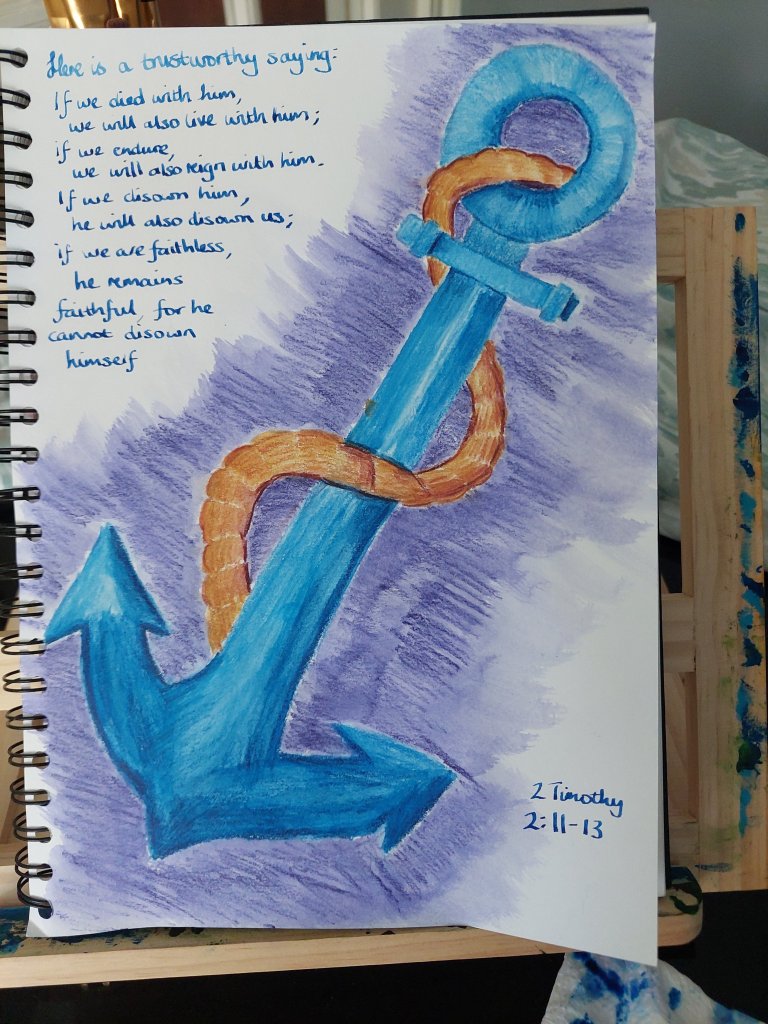
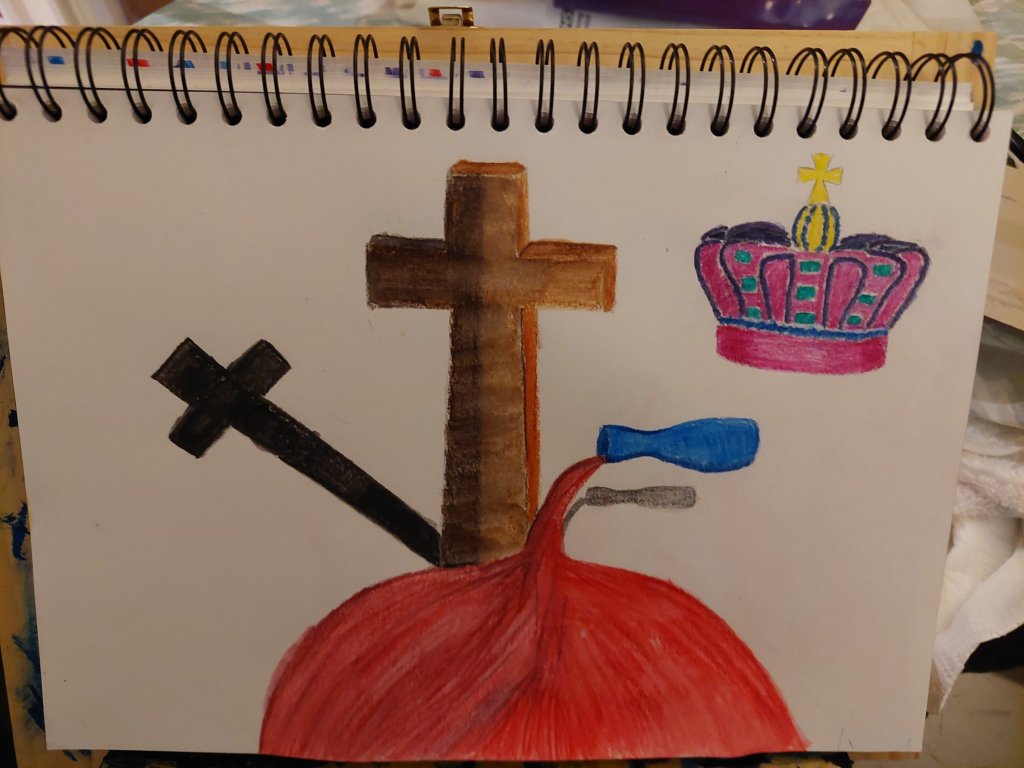
2 Timothy art

I’ve been quite ill for the past couple of months, and sadly unable to do one of my favourite things- preaching and teaching from Scripture. I was due to preach at the at the beginning of October, but I wasn’t well enough. Instead, my vicar preached, but, knowing how important a part of ministry and calling preaching and teaching is, and knowing that I love to listen to God and create prophetic art, he asked me to do that with the passage I would have preached from. He would then use my art as the starting point for his sermon.

So that started a month of creating art inspired by 2 Timothy: 2 Timothy 1:1-14; 2 Timothy 2: 8-15; 2 Timothy 3: 14-4:5 and 2 Timothy 4:6-8.

I also felt prompted to do a similar piece from Hebrews 6:19

I hope these pictures speak to you and prompt your own exploration of these passages and what God is saying to you through them.

Disability Inclusion

Inclusion… what does it look like to you?

Before I say anymore, I need to add that every disabled person is different, in personality, interests, disability and acceptance of their disability, and so we all have different accessibility needs. What I want to share with you today is how a special group of friends from a church group continually include and enable me.

I’m part of a Mission-Shaped Community for young adults in Leicester. I have both a physical disability which affects my mobility, and dyspraxia, which, as well as making mobility even more complicated, also particularly affects me in social settings, conversations and with social etiquette and non-verbal cues. Both of these could have a significant impact on how included I feel with my MSC – but here are a few examples of how this lovely bunch, support me, love me, encourage me, cheer me on, celebrate small victories with me and include me.

1) They encourage me with my physio, cheer me on with physical exercise (however “insignificant”), and encourage me to keep persevering.

For the first time since I lived ‘in community’ at college, I have a friend who keeps me accountable with doing my physio, and since we agreed that, I’ve not completely missed a physio time.

2) One day-to-day impact of my disabilites is that I struggle with housework and with cooking, and the organisation needed to do it at for a particular time… but I would love to be able to have friends round for dinner, and to host house groups. I live alone.

Earlier this year, I did host house group, and whilst I had a lot of help from my parents with the housework, these friends were never phased, whether I’d ‘frozen’ trying to prepare food, get things ready, or whether the flat wasn’t *at all* ready for guests. The way they just got on with making it possible, and then were willing to come back(!) was one of the ways I knew I was truly loved.

3) they adapt socials so I can join in. Physically, it’s clearly easier for me to sit on a sofa as part of a Bible study, than a lot of other activities we could do. But as a group, we do socials that lots of folk enjoy, and we make it possible for people to join in if they want to:

a) We go to meals at restaurants. There are a lot of logistics that you wouldn’t think of (unless you have a physical disability) to tidy up before you can eat at a restaurant:

– parking – how close is the parking, and if it’s further away, how can I get there?

– where is the table? Lots of restaurants have flights of stairs and/or the odd step here and there (without handrails) in parts of the restaurant. If I reserved the table, I will triple check that they have a seating area with level or only a few steps access, and request a table in the most accessible area (in terms of steps) of the restaurant. But that’s not always possible, and that shouldn’t mean I don’t get to go to that restaurant. We usually find restaurants close to parking, but if not, my friends will meet me and help me to get to the restaurant.

If there are steps/ flights of stairs, this group of friends help me up them, make sure I’m safe, and I know I can trust them to catch me if I wobble!

– Table height! I’m short, and I don’t have the power in my legs to jump, so bar stools/chairs are near-on impossible for me to get on, on my own. Sometimes, restaurants unexpectedly have these chairs, and sometimes it’s not possible to have a “normal height” table. When that happened, my friends found a way to get me onto a seat, so I could enjoy the meal.

b) when we played sardines, they suggested I be the person people looked for, so that it wasn’t necessary for me to go upstairs

c) Yesterday, we played crazy golf. Lots of people might have said I shouldn’t have gone – especially as I was already in pain. But I love crazy golf (I used to play ‘real’ golf as a child/teenager), and I’m stubborn!

So, I took 2 walking sticks and a pop-up stool. My friends then all got me, the 2 walking sticks, stool and putter safely round (we’ll forget the golf ball 😉), without injury to me or them, up and down steps and steep slopes, across bridges and so on, often meaning someone had to double-back on holes so that we could all play. All were happy to help, and made sure I knew they wanted me there.

I was asked if I wanted to stop early, and I refused, so they simply said ‘you decide when to stop’. I’m so thankful for this. Too often with these kinds of activities, people, even good friends, try to tell disabled people what they should or shouldn’t do.

Occasionally this is necessary. For me, this is generally when I look pale, drawn and generally exhausted, and there is a clear risk of actual harm. Most often this is a result of too much socialising/conversation, rather than physical. If I decide to do something, I know there will be physical pay-back/pain, and I want to do it anyway, and I have ‘counted the cost’ and decided that, on this occasion, it’s worth it. So these kinds of interventions should be very rare.

The key thing is that having agency, and being “allowed” to make those decisions shows much more love, care and inclusion than either avoiding an activity altogether (that just means I feel guilty for other missing out!) or making me sit out (there is nothing I hate more than having to sit and watch others do something I want to do, just because of my disability).

4) They support, enable and cheer me on to do other things. Like the time when we were at a bigger event, and there was an inflatable assault course:

Inflatable assault course with rollers, bollards, tunnels and a rope climbing wall

Now, I have never really been able to properly stand, balance, walk or jump on inflatable things like this – it had been years since I’d tried and even as a child I’d had to pair with my twin sister to properly enjoy bouncy castles. But I really wanted to have a go!

A friend from this group saw I wanted to go on it, and paired with me (it’s meant to be a race). I crawled through most of it, and then my friend helped me stand up and balanced for the last bit. Then we had to get me over the climbing wall. I held onto the ropes, my friend pushed, and another friend from the group (a tall friend), pulled from the other side. Other friends cheered us on from the side lines, and held my stick. I’m not sure how long it took, but eventually, we got me over the climbing wall 😀

I know that this group of friends would do all this for anyone, but it’s made such a difference to me – not just that they will do it – but that as they do it, they make me know that they love me and want me there, and involved.

Pentecost 2022

Yesterday, on the final day of Elizabeth II’s Plantinum Jubilee celebrations, I led matins for the first time. The Book of Common Prayer morning prayer service is Queen Elizabeth’s favourite service.

More importantly, it was the feast of Pentecost, and I had the privilege of preaching the following sermon. The audio will be linked to when it is available.

Today I’m going to invite you on a journey of your imagination, first as someone in the Jerusalem crowd, and then as a disciple who had been waiting for, and received the Holy Spirit.

Imagine you are a Jew from Parthia, come to stay in Jerusalem for the Festival of Weeks. Your friend has been
telling you about the events of the Passover, including the crucifixion of a man from Nazareth whom you saw do deeds of power, signs and wonders, last time you were here. Then, you’d wondered whether He could be the Messiah. Now, there were rumours that he’d risen from the dead, and the soldiers guarded his tomb had been executed. But those were just rumours. How could you know if they were true?

You step out, early in the morning, to go to the market. What can you smell?

The city is busy, full of people from all over the Roman Empire, What can you hear?

Suddenly, the noise around you increases. There’s a great crowd of people gathering, bewildered, nearby, you wonder what’s going on. You find some Galileans, speaking in all sorts of languages! Suddenly you hear one speaking in your native languages, Aramaic and Parthian.

Someone is shouting over the noise, telling you about how God has raised someone from the dead, healed the sick, forgiven sins!

What are you thinking? What are you feeling?

One of the men who had been speaking in many languages,
starts speaking in the common language, Greek. “These people can’t be drunk – it’s only 9 in the morning!”. He explains that this is what prophet Joel had spoken about, of the coming of the Lord’s day. He reminds you about Jesus of Nazareth. Jesus, the man you remembered, wasn’t just any man. He was God’s man, the Holy One, the Messiah. Jesus is the one that has been raised from the dead, the rumours are true! He reminds the crowd that it was them that crucified this Lord, the Messiah.

What are you thinking? What are you feeling?

Perhaps you feel weighed down by the things you have done wrong, or perhaps you are wondering how anyone could be raised from the dead. Perhaps you feel desperate for God to do something in your life, or in the lives of those you love. Could that be possible?

Then the reassurance comes. You can receive God’s gift, your sins can be forgiven. You can receive power from God, like these people had!

You can’t just walk away. You will be forever changed.

It was only 10 days ago that Jesus had taken us out of the city, and we’d asked him whether he was going to restore the kingdom of Israel. He’d told us we couldn’t know the times that the Father sets, that we needed to focus on telling the whole earth about who He was, what He had done, all that we had seen. Jesus had told us that we needed to wait for a promised gift from God, when power would come upon us.
With that task, we’d certainly need it! It still felt like a long
time though, I’d never been good at waiting!

We returned to the house, and devoted ourselves to prayer,
settling in to wait, but I confess, I was starting to feel a bit
fidgety! Then… on the day of Pentecost, we thought we’d
heard a violent wind, filling the entire house. Little whisps,
tongues, of what looked like fire, rested on those around me,
and I knew by the way the others looked at me, that one
rested on me too. I felt this sense of power, and then I began
to speak. Well, I say speak, but I have no idea what I was
saying! We were all compelled to go out into the streets, and
words which we didn’t understand flooded out of our
mouths. Somehow, I knew that we were doing what Jesus
had told us to – speaking about all of the wonders of God. A
crowd started to gather around us with lots of muttering.
Some were wondering what it was all about, but others were
laughing at us and saying we were drunk.

Peter spoke up. I’m not quite sure how he knew what was
going on, it must have been the new power we’d received
from God. He spoke of prophecy, of dreams and visions, and
the coming day of the Lord. He spoke of Jesus of Nazareth,
who He was, what He did, and what God had done in raising
Him from the dead. He told the crowd that Jesus had been
“freed from death, because it was impossible for him to be
held in its power.” Peter understood that this was the
promise of God, not just for us, but for all who believed in
Jesus! This gift, poured out for others to see and hear, so that they might believe. He urged the crowd to repent, and be baptised in the name of Jesus Christ. He said that by repenting and being baptised, their sins would be forgiven, and they, too, would receive the gift of the Holy Spirit.

This promise is for everyone whom the Lord our God calls to
Him. That day, God added 3000 people to our number, and
somehow, we weren’t surprised. It was like it was meant to
be, as soon as we received the power of God in that house.

I’m going to read a few portions of the part of Peter’s sermon
that we didn’t have read earlier.

As I read them, let the words sink into your heart, and open yourselves up to what God wants to do in you and through you.

“… listen to this: Jesus of Nazareth was a man accredited by God to you by miracles, wonders and signs, which God did among you through him… This man was handed over to you
by God’s deliberate plan and foreknowledge, and you, with
the help of wicked men, put him to death by nailing him to
the cross. But God raised him from the dead, freeing him
from the agony of death, because it was impossible for death
to keep its hold on him.”

“Therefore let all Israel be assured of this: God has made this Jesus, whom you crucified, both Lord and Messiah.”

“Repent and be baptised, every one of you, in the name of
Jesus Christ for the forgiveness of your sins. And you will receive the gift of the Holy Spirit. The promise is for you and your children and all who are far off – for all whom the Lord our God will call.”

If you have never come to Christ or received the Holy Spirit, I invite you to say this prayer in your head with me, and then
we will hold a couple of minutes of silence before we sing the
next hymn. You may find it helpful to hold your hands out in
front of you as you pray.

“Father God, I repent of my sins. I turn around and choose to
follow you and your ways today, in the name of Jesus Christ,
who was crucified, and whom you have raised from the dead.
I need your Holy Spirit to give me your power to live life your way. Come, Holy Spirit.

Weaving tapestries of realistic hope

This sermon was first shared at St Denys Evington on 03.04.22, the 5th Sunday of Lent. A recording of the sermon is available here.

Isaiah is one of my favourite books in the Bible. Now, I know that I say something similar about almost every passage I preach on, but Isaiah has a particular draw for me, that constantly brings me back to the rich tapestry I find in it. The reason is that that tapestry is a tapestry of realistic hope.

Hope because Isaiah consistently reminds the people of Israel of the LORD, and His character of
goodness and righteousness, mercy and faithfulness, and the hope that comes from knowing the LORD.

Realistic because Isaiah is honest, often brutally so, about Israel’s sin and failure to be the people
they were called to be as God’s chosen people, and the consequences of that.

A tapestry because a tapestry is a beautiful wall hanging created by weaving coloured warp threads
through a plain-coloured weft.

Isaiah is a tapestry created from wefts of realism woven with the
brightly coloured warp of hope. In many ways Isaiah is a small part of the tapestry of the whole
Bible, which tells the story of humanity, through which we understand the tapestries of our own lives, which through God’s Spirit at work in us, can become tapestries of realistic hope.

This section of Isaiah contrasts God’s mercy with Israel’s unfaithfulness. We join the passage as God speaks through Isaiah to remind Israel of who He is, taking the people back to the foundation event of their history – the parting of the Red Sea. This opening sets the foundation for the promise that follows. Something new is coming, like water in the wilderness, like streams in the wasteland. In this
part of the tapestry we are seeing the coloured warp, the reading stops before we glimpse the weft.
The section immediately after our reading is the weft – the reality of Israel’s circumstance
because of their sin and failure. The LORD tells Israel, “you have burdened me with your sins and
wearied me with your offenses.” And yet… immediately, hope returns, God declaring, “I, even I, am he who blots out your transgressions, for my own sake, and remembers your sins no more.”

I wonder...


Who would you be more likely to trust to keep their promises: someone whom you have known for years, and have seen what they’ve done in the past and know their character, or someone you don’t know so well?

This part of Isaiah is written to the Israelites in exile in Babylon, so these verses not only remind
them of who God is, they also assure them of hope for a future of freedom. By remembering that
God has done it before, they can be more confident that God will do something similar again now.

God is unchanging, and yet, Isaiah’s prophecy is that God is “doing a new thing”, and Israel is
commanded not to dwell on the past. The theologian Alec Motyer puts it quite a catchy way – “The
LORD is revealed in the past, but he is always more than the past revealed.” – God always has greater things in store, for Israel and for His people now – you and me, not just in terms of circumstances, but also our relationship with Him.

This passage could first be read as giving a promise of the end of exile, a change to the practical
circumstances that the people of God find themselves in. That is all true, God can, and does, bring
about changes to people’s practical circumstances. But the bigger tapestry of the whole Bible shows us that the historical story Isaiah refers to, of the oppression in Egypt, The Exodus and arrival in the Promised Land, and the historical story He is speaking into, of sin and failure resulting in exile and the restoration and return from exile are both patterns of a bigger story. A story of sin and failure across the whole of humanity resulting
in a broken relationship with our loving Creator, which is restored through the incarnation, death
and resurrection of God Himself, in Jesus Christ. A story of redemption which belongs to each one of us who has accepted Jesus Christ as Lord. In Christ, we have freedom from our sins and failures, even when we’ve totally let God down, because in Christ God is doing a new thing. He’s providing water in the wilderness and streams in the wasteland, giving drink to His people, whom He formed for
Himself, so that we may proclaim His praise.

Wilderness and wasteland are not places you expect to find water or streams to drink and for
refreshment. Another reminder of the Exodus, when God provided water from rocks, food from the heavens and sustained and refreshed His people, the promise of water in the wilderness and streams in the wasteland is a promise that God can do what no one else can.

He can transform even the most hopeless of cases, those that others might write off. If you feel that you are beyond help, you are not. If you feel or think that you would write yourself off, God does not, and will not write you off. Whatever has happened in the past, done to you or done by you, whatever the reality of
your life, God is doing a new thing, and He will bring water in the wilderness and streams in the
wasteland. Even, or perhaps especially, if that seems impossible to you. God is weaving you, your own tapestry of realistic hope.

I’d like to share with you a testimony from someone who has found this promise to be true:

As you finish, you might want to pray this prayer, and spend some time waiting on God:

Come Holy Spirit, bring water in the wasteland and streams in the desert, do a new thing in our lives. Restore what seems irreparably broken, reconcile relationships that seem shattered and bring healing to our lives, that we may proclaim your praise. Amen.

Christ the King and Ability Sunday

This sermon was originally shared with a specific congregation on 21st November 2021, so the recording reflects this by speaking to specific situations within that context. I have tried to edit this text so that it is more widely applicable.

Today, we proclaim that Christ is King. What kind of King is He, what does that mean for us, and what difference does that make for how we live our lives as Christians and as the Church?

What kind of King is Jesus?

Immediately before our gospel passage, Jesus is handed over to Pilate by the Jewish leaders. We don’t get to hear their accusation, but we can make a reasonable guess from the question Pilate asks, “Are you the King of the Jews?”.

The Jewish leaders’ real complaint is that Jesus is claiming to be the Messiah, God’s anointed, indeed, claiming to be God. “The King of the Jews” would be a reasonable translation of this for a non-Jewish politician, with the benefit of alerting Pilate to the possibility of political rebellion.

Jesus sees through Pilate’s question, and, returning with a question of his own, puts Pilate on the back foot, before explaining what his kingdom or kingship is not:

–         It is not from, or of, this world – it has different origins

–         This means that it works differently – the example Jesus gives is that, in contrast to the kings ‘of this world’, his followers were not fighting to prevent his arrest, trial or execution by the Jewish leaders.

–         Jesus is a different kind of King. Jesus has power and authority which does not depend on recognition from human leaders, rulers or followers.

So if Jesus’ kingship is NOT like other kingdoms or kingships, what IS it like?

As the exchange with Pilate continues, Jesus presents Pilate with a challenge and an opportunity to recognise His kingship. Jesus defines His kingship by His testimony to the truth, and those who belong to the truth listen to His voice – they are the ones who recognise His kingship. In our so called, ‘post-truth’ age, where seemingly everything is subjective, Pilate’s question (which immediately follows the reading we heard), has almost become the question of our age “what is truth?”. Earlier in John’s gospel, Jesus said “I am the Way, the Truth and the Life”, truth is a person, and that person is Jesus Christ, the king of Truth.

Just as Pilate was, we too are invited to know the King of Truth.

If the King of Truth stood before you today, how would you respond?

Now for our reading from Revelation. A lot of us find the Book of Revelation confusing and intimidating, and that’s quite understandable. There are so many genres – types of writing – within the letter of Revelation, that it can be hard to work out what’s going on when. Our passage today is a good example – within these 4 verses, there are 3 different types of writing – letter writing; prophetic writing and writing in a style called doxological, which means that it is written to give praise, worship and glory.

The author, John, starts this section with the standard letter-writing greetings of the time, but like Paul, adapts them to give them a particularly Christian flavour – instead of “greetings from the gods” he shares “grace and peace” from the Trinitarian God – Father, Spirit, Son. The ‘seven spirits’ mentioned in the middle of verse 4 is a way of describing the fullness of divine power – the Holy Spirit. Jesus Christ is identified with three key descriptors – faithful witness, the firstborn of the dead and the ruler of the kings of the earth, and then John switches to praising and worshipping Jesus. Jesus is the One who loves us and freed us from our sins by his blood.


Now, as confusing as Revelation can be, it is often one of my favourite parts of the Bible, because it draws together so many of the themes from elsewhere in the Bible

Have a moment to think about what themes you notice in this passage.

–         Faithful witness – reminds us again of Jesus being the one who testifies to the truth, who is the Truth.

–         Firstborn of the dead – has echoes of the powerful passage in Colossians 1, and 1 Corinthians 15, where Paul focuses on the importance of the physical resurrection

–         Ruler of the kings of the earth – King of Kings – a title given to Jesus in 1 Timothy 6, later on in Revelation, as well as promises to David in the Old Testament, particularly psalm 89.

–         “freed us from our sins by his blood” – In John 8, as he is in discussion with a group of aspiring disciples, “If you continue in my word, you are truly my disciples; and you will know the truth, and the truth will make you free”, and goes on to explain that the freedom that He brings is freedom from sin.

Jesus’ kingship is defined by his witness to the truth, his sacrifice and his resurrection, and so he has power and authority over all the kings, rulers and governments of the earth – he is the King of Kings.

What does this mean for us?

The power of the King of Truth dying for our sins cannot be diminished and must not be under-stated.

Each one of us, until we turn to Jesus, is imprisoned by our sins, and we cannot free ourselves. Jesus’ kingship is about his ability as the king who bring salvation, by becoming the One who bore our curse for us, to set us free.

I will repeat that again. Each one of us, each one of you, is freed by Jesus’ blood when we turn to Him and follow Him and continue in His word.

So what does this mean for how we live as Christians, and as Church?

Having been freed from our sins by his blood, Jesus has made us to be a kingdom, priests serving his God and Father. No, I don’t mean we all need to get ordained! It’s a reference to Exodus 19:6, where God calls His people to be a ‘priestly kingdom and a holy nation’. The key point that John is making with this reference is that Jesus’ death achieves what God had always intended for his people in the beginning. Followers of Jesus have been redeemed (freedom bought at a cost) from slavery to sin, and we are on a journey to the promised land. Our role is to live under the reign of God as people who make God known and intercede for the world. That sounds great, but you might be wondering what that might look like practically!

As well as being the feast of Christ the King, today is also Ability Sunday, a day to recognise, celebrate and include the diversity of abilities within our congregation, and this year the theme is ‘connection’.

During the pandemic many people who struggled to attend church in person, perhaps due to physical disabilities, mental health difficulties, sensory processing difficulties or ill health and many more, were able to participate much more in services because services went online, and so could be accessed from home. We know, of course, that others felt excluded and unable to participate because they didn’t have internet access, or the confidence to use it.

Here at St Denys we tried to provide every possible way for everyone to access church and stay connected – online and with landline access, recordings that could be accessed by landline telephone as well as online, digital bulletins and paper copies.

We’re now back in church. But those who couldn’t get to church before the pandemic, still struggle to get to church, and sadly as a result of Covid there are others who are less able to attend church, too. We still want to connect with them and enable them to participate in our worship as much as they are able, and that’s the reason why we are still trying to use Zoom to stream our services. Other churches use other software, but we have stayed with Zoom because it enables people at home to read the Bible, lead intercessions, or even to preach or perhaps lead services from home, and we know and have heard how valuable that is to those who cannot come to church in person, and you have seen that today too, with our readings.

This work of building connection, which is an important making God known through the way we love one another, is a job for all of us, in a variety of forms.

One of the ways that we really need help to do this is to continue to enable people to join in the service from home via Zoom.

We’re planning some more training soon, and we will take you through it step-by-step. Once the equipment is set up (which a number of us are able to help with), it is simply a case of tabbing the PowerPoint on to the next slide – you can do that by pressing just one button! So please do prayerfully consider whether you could do this, with support and encouragement from us, because the reality is that the current situation is unsustainable.

If you don’t feel able to be involved with the PowerPoint and tech, there are lots of other ways you can make God known through connection:

–  Meet members of your wider community, building connection and friendships

–         Pick up the phone to someone you haven’t seen in a while and ask how they are, if you are aware of a pastoral need, please pass this on to your church pastoral team.

–       If your church has a drop-in or open church, be available for people from the community to feel welcome

In your personal lives:

–         Helping friends and neighbours with practical tasks like shopping, collecting prescriptions etc

–         Cooking meals for friends and neighbours when you know they are struggling

–         Being a listening ear

… and much more!

We will all find ourselves in different places during the week – work, school, visiting cafés, spending time with friends, being at home.

Where will you be this week? How could you make God known and build connections in those places this week? I encourage you to spend some time chatting with the person next to you about these questions – but if you would rather keep your distance today, please just reflect quietly where you are.